Peer Mediation in Schools: A Practical Implementation Guide
← Back to Blog
🏫 K–12 Schools

Peer Mediation in Schools: A Practical Implementation Guide

May 10, 2026·27 min readpeer mediation in schoolsconflict resolutionschool discipline

A lot of schools are in the same place right now. A hallway argument starts with a group chat, spills into lunch, reaches a teacher during class, then lands in the dean's office by last period. Nobody is dealing with a major safety incident, but adults still lose instructional time, counselors get pulled into preventable drama, and students walk away feeling either punished or unheard.

That's where peer mediation in schools becomes more than a standalone initiative. Done well, it changes how a school responds to ordinary conflict before ordinary conflict becomes chronic conflict. It gives students a structured way to repair harm, practice communication, and take responsibility. It also gives staff a consistent alternative to reflexive punishment for disputes that are relational, not dangerous.

The schools that sustain this work don't treat peer mediation as a side project run by one enthusiastic adult. They build it into discipline decisions, counseling referrals, advisory lessons, and everyday expectations about how people speak to one another. That's the difference between launching a program and building a culture.

Why Peer Mediation Is a Powerful Tool for Modern Schools

Third period ends, two students leave class angry, and by lunch half the grade has heard a version of the story. One student says the comment was disrespectful. The other says it was sarcasm taken too seriously. A teacher intervenes, the office assigns a consequence, and the hallway settles down for the day. By tomorrow, the conflict has usually shifted to group chats, side comments, and friends taking sides.

School leaders see this pattern all the time. Traditional discipline is designed to stop behavior, set limits, and protect safety. Schools still need that. But many student conflicts are rooted in damaged trust, social status, embarrassment, rumor, or misread intent. Consequences can contain the disruption without resolving the relationship that keeps producing it.

Peer mediation gives schools another response for the conflicts that sit in that middle zone. The goal is not to decide who wins. The goal is to help students explain what happened, hear the impact, and reach a workable agreement they can live with in the same building the next day.

That difference matters because students do not leave their conflicts at the office door. They carry them into class, lunch, sports, attendance patterns, and counseling visits. A school that treats peer mediation as a side program misses the larger benefit. Used well, it becomes part of how the school teaches students to handle friction before it hardens into harassment, chronic defiance, or repeated office referrals.

Why students often respond to peer mediation

Students are often more candid with trained peers than with adults in authority. They may admit embarrassment, jealousy, social pressure, or fear of looking weak long before they say those things to an assistant principal. That does not make peer mediators substitutes for adults. It makes them a structured first line for the right cases, with adults screening risk, supervising the process, and stepping in when a conflict falls outside mediation.

In practice, peer mediation works because it addresses the part of conflict that punishment usually cannot reach. Students get a chance to clarify intent, name impact, correct false assumptions, and make specific commitments about what happens next.

Those are school climate skills, not just meeting skills.

Students learn to pause before reacting, listen for the actual issue, and separate a public performance from the private concern underneath it. Teachers benefit when students bring fewer unresolved disputes back into the classroom. Counselors benefit when a manageable peer conflict is handled early instead of becoming a larger emotional or behavioral problem a week later.

Practical rule: Use peer mediation when participation is voluntary, the students can speak for themselves, the relationship is repairable, and the school can keep the process safe.

Why this matters beyond a single incident

Schools sometimes launch peer mediation because they want fewer office referrals. That is a reasonable starting point, but it is too narrow. The stronger case is that peer mediation helps a school build a repeatable conflict-resolution culture.

That culture shows up in small, observable ways. Staff start referring appropriate conflicts earlier. Students hear a common language for harm, accountability, and repair. Classroom teachers spend less time informally arbitrating the same disputes. Counseling and discipline teams get a better option for low-to-moderate interpersonal conflict that does not require either ignoring the issue or escalating it.

There are trade-offs. Peer mediation takes staff time, training, screening, supervision, and scheduling. It will not fit every conflict, and it should never be used for cases involving threats, coercion, serious bullying, harassment, dating violence, or major power imbalances. But for everyday peer conflict, the kind that drains attention and keeps resurfacing, it gives schools a practical way to respond without relying on punishment alone.

That is why schools that sustain this work do not treat it as an isolated student activity. They place it alongside discipline, counseling, and classroom practice as one part of a broader conflict-resolution system. When that happens, peer mediation stops being a poster in the counseling office and starts becoming part of how the school operates.

Laying the Groundwork for Your Peer Mediation Program

Third period ends, two students leave class angry, a teacher sends one to the office, the other goes to a counselor, and by lunch three adults have spent time on a conflict that will probably flare up again tomorrow. That is the point where many schools decide they need peer mediation. The launch often stalls because the school treats mediation as a small student program instead of building it into the way conflict is handled across classrooms, counseling, and discipline.

A workable start depends on adult alignment before the first student takes a case. School leaders need clear answers to three operational questions. Who owns the program. Which cases fit. How the process connects to existing priorities, routines, and student support systems.

A pencil sketch shows hands arranging gears to form a foundation next to a blueprint for goals.

Start with an adult team that can carry the work

Peer mediation lasts longer when it sits with a cross-functional team rather than one enthusiastic staff member. In practice, I recommend a small steering team that includes the people who already deal with conflict from different angles and can solve the predictable problems of scheduling, referrals, supervision, and parent questions.

Include:

  • An administrator with decision-making authority so referral procedures and scheduling can be approved quickly.
  • A counselor, psychologist, or social worker who can screen for risk, support students, and advise on confidentiality.
  • At least two classroom teachers from different grade levels or departments.
  • A dean, behavior specialist, or assistant principal if your school routes conflict through a discipline office.
  • A skeptical staff member who will pressure-test the plan before the rest of the faculty does.
  • A family-facing representative such as a parent liaison, when possible.

This group should settle the practical details before launch. Define the referral path, case exclusions, consent procedures, supervision plan, documentation rules, communication templates, and where sessions will happen. If those decisions stay loose, staff will create their own versions, and students will get different answers depending on which adult they ask.

Set goals that fit the school you actually have

Schools lose momentum when peer mediation is described in broad climate language but never tied to daily operations. Goals should match the problems your leadership team is already trying to solve.

Common examples include:

  1. Reducing repeat referrals for interpersonal conflict
  2. Creating a structured response for appropriate cases that do not need punishment
  3. Giving students a visible leadership role in solving peer disputes
  4. Teaching conflict-resolution skills that teachers and counselors can reinforce in other settings
  5. Reducing the amount of staff time spent informally refereeing the same disputes

This is also where the culture question matters. If the school wants mediation to last, it cannot sit off to the side as a counseling project. Place it inside systems that already exist, such as restorative practices, MTSS, behavior support, advisory, or SEL instruction. A program with no operational home usually fades once the launch energy wears off.

Decide early what belongs in mediation, and what does not

Schools get into trouble when they start with training materials but skip case criteria. Student mediators need appropriate cases. Staff need a fast way to know when a conflict should go to administration, counseling, threat assessment, or another formal response.

Peer mediation usually fits low-to-moderate peer conflict where both students can participate voluntarily and there is no serious safety concern. It does not fit threats, coercion, harassment, dating violence, serious bullying, significant power imbalance, or situations where a student cannot speak freely. Put those exclusions in writing. Review them with staff more than once.

A simple decision tool helps. Some schools use a one-page referral guide with two columns: "appropriate for mediation" and "adult-managed only." That saves time and protects students.

Build staff and family trust before the first referral

Teachers need to know what will happen to instructional time. Counselors need to know mediation will not replace mental health support. Families need to hear, in plain language, that participation is voluntary and that some cases require direct adult intervention.

Cover four points every time you introduce the program:

  • Participation is voluntary. Forced mediation produces guarded conversations and weak agreements.
  • Some cases are excluded. Safety and power imbalance come first.
  • Student mediators are trained and supervised. Adults remain responsible for screening, support, and follow-up.
  • Agreements need to be specific. Clear next steps hold up better than broad promises to "be respectful."

I also advise schools to explain the trade-off clearly. Mediation takes time to coordinate. There will be a learning curve. Some referrals will be screened out. Staff are more likely to support the program when leaders describe it as a disciplined process, not a quick fix.

Build the operating system, not just the event

A school can train students well and still get poor results if the adults have not built the routine around them. The launch plan should answer who receives referrals, who screens them, how students are scheduled, how teachers are notified, where records are stored, how agreements are monitored, and when the team reviews trends.

A practical launch checklist helps:

  • Name one coordinator. One person should track referrals, scheduling, supervision, and follow-up.
  • Choose a predictable location. Students need a private, calm room that is available consistently.
  • Create one referral route. A single form or process gets used more often than multiple options.
  • Write one-page staff guidance. Keep it concrete: what to refer, what not to refer, and what response time to expect.
  • Plan regular visibility points. Staff meetings, advisory, family newsletters, and student assemblies keep the process in view.
  • Align training with your procedures. If your team is still building that piece, this guide on how to train peer mediators for real school conflict situations is a useful reference.

Done well, groundwork changes more than referral numbers. It gives the school a shared way to respond to ordinary conflict before it hardens into discipline patterns, counseling overload, or chronic classroom disruption. That is the difference between a short-lived program and a conflict-resolution culture students and staff can use.

Recruiting and Training Your Student Mediator Corps

A school can recruit a polished group of student leaders, give them shirts and scripts, and still end up with an unused mediation room. Students bring conflict to peers they trust. If the mediator corps feels handpicked by adults, socially narrow, or disconnected from daily student life, referrals dry up fast.

That is why recruitment is not just a staffing task. It is an early culture decision. The students selected for this role signal whether peer mediation belongs to the whole school or only to a small leadership circle.

The strongest mediator corps looks like the school students experience every day. Include students across grade levels, social groups, cultures, language backgrounds, and activity circles. Some will be formal leaders. Some will be the students classmates already seek out after lunch, in the hallway, or during group work.

A line drawing illustration showing a group of students participating in a peer mediation training session.

Choose students other students will trust

Schools often make the same recruitment mistake. They select only students with spotless behavior, strong grades, and high teacher approval. Those students may become excellent mediators, but a full team built that way usually misses the students who carry informal influence with their peers.

Look for students who show judgment and steadiness in ordinary school moments:

  • Peers seek them out. They have informal credibility.
  • They stay calm under pressure. They do not need to control the room.
  • They can hold confidence. They understand private information should be handled carefully.
  • They can be fair even when they know the students involved.
  • They accept coaching and practice seriously.

Use more than one recruitment path. Staff nominations alone tend to produce a narrow pool. Add self-nominations and peer nominations, then do short interviews. Ask what fairness looks like, how they respond when a friend expects special treatment, and what they would do if they felt biased toward one student in a conflict.

A mixed cohort usually serves the school better than a uniformly polished one. Schools can teach mediation skills. Earning peer trust is much harder once students have already decided the program is only for a select few.

Train for live conflict, not for the brochure

Training should prepare students for real conversations that include tears, sarcasm, silence, blame, and sudden defensiveness. A lecture on empathy is not enough. Students need rehearsal, correction, and repeated practice under adult supervision.

In most schools, training works best when it is spread across multiple sessions rather than compressed into one long block. That gives students time to absorb the process, try new language, and return with questions. It also fits school reality better. Pulling students for a full day is difficult in many buildings, especially when testing, athletics, and staffing gaps are already squeezing the schedule.

Key training strands should include:

  • Conflict basics
    Students need a simple explanation of how conflict escalates, how assumptions take hold, and why intent and impact often differ.

  • Active listening
    Practice paraphrasing, summarizing, checking meaning, and naming emotion without judgment.

  • Neutrality
    This is difficult for adolescents and adults alike. Mediators must avoid siding, advising, correcting, or signaling which student seems more reasonable.

  • Confidentiality and limits
    Students need exact language for what stays private and what must be shared with an adult because of safety, harassment, threats, or abuse concerns.

  • Questioning and reframing
    “So you think he lied” raises the temperature. “It sounds like trust was damaged” keeps the conversation usable.

  • Agreement writing
    Students should practice turning vague promises into specific actions, timelines, and follow-up steps.

Schools building a training sequence can use this practical guide on how to train peer mediators for real school conflict situations as a supplement to staff-led coaching.

Practice until the language becomes usable under stress

Role-play is where student mediators become credible. Start with low-intensity disputes, such as misunderstandings in group work or gossip between friends. Then move to harder scenarios involving social media, exclusion, friendship changes, or repeated classroom friction. Keep the cases appropriate for peer mediation and close enough to school life that students recognize them.

This kind of demonstration can help students visualize what a real process sounds like before they lead one:

Debrief each practice round with precision. General praise does not build skill. Specific feedback does.

Coach for behaviors you can hear and see. “Slow your pace.” “Summarize each student before asking the next question.” “Stop the interruption and restate the ground rule.” Students improve faster when feedback is concrete.

Several training problems show up repeatedly in schools:

  • Too much theory and too little rehearsal
  • Weak confidentiality practice
  • Role-plays dominated by confident personalities
  • Assuming older students need less supervision
  • No plan for post-training coaching

Training also needs a clear connection to the rest of school life. If student mediators learn one approach in training but teachers, counselors, and assistant principals use different language around conflict, the program stays isolated. The goal is broader than producing a few capable student facilitators. The goal is to build shared habits around listening, repair, accountability, and problem-solving that can show up in advisory, classrooms, counseling offices, and discipline responses.

That is why ongoing supervision matters. Hold regular check-ins. Review difficult cases without sharing unnecessary details. Let mediators rehearse openings, closings, and common stuck points. Treat the corps as a developing leadership team with adult backing, clear standards, and room to grow over time.

Structuring the Mediation Session for Success

Consistency matters more than style. Students don't need a clever process. They need a stable one. A clear routine lowers anxiety, protects fairness, and helps inexperienced mediators stay grounded when a conversation gets tense.

The strongest peer mediation in schools uses a structured six-step protocol. A meta-analytic review of 4,327 mediations found that 4,028 reached agreement, for an average success rate of 93%, and the review ties that success to the use of a clear six-step model in this evaluation of peer mediation outcomes in education.

A diagram illustrating the six sequential steps of peer mediation process in a school setting.

Use the same workflow every time

A standard process helps for three reasons. It reassures students that the session is fair. It keeps mediators from rushing to solutions too soon. It gives adults a clear way to supervise quality.

The six phases are straightforward:

  1. Introduction
  2. Gathering information
  3. Identifying issues
  4. Generating options
  5. Negotiation and agreement
  6. Closing

Room setup matters too. Use a private space with chairs at equal height, no desk separating students, and minimal interruptions. Keep paper, pens, tissues, and the agreement form ready. If the space feels improvised, students will treat the process as optional and fragile.

The six phases of a peer mediation session

Phase Mediator's Goal Sample Mediator Script
Introduction Establish safety, neutrality, and ground rules “Thanks for meeting today. We're here to help both of you talk through the conflict and see if you can reach an agreement. We won't take sides.”
Gathering information Let each student tell their story without interruption “Tell us what happened from your point of view. The other person will have a turn too.”
Identifying issues Clarify the main disagreements and underlying needs “What do you think the main problem is right now?”
Generating options Move from blame to possible solutions “What could make this situation better going forward?”
Negotiation and agreement Shape realistic commitments both students can accept “Which of these ideas feels fair and specific enough to try?”
Closing Confirm next steps and end with clarity “Let's read the agreement back together and decide how follow-up will happen.”

A few scripting habits make sessions stronger:

  • Open with voluntariness. Students should hear that they can choose to participate.
  • Name confidentiality and its limits clearly.
  • Summarize often. Don't let a long emotional statement pass without checking understanding.
  • Slow the pace before problem-solving. Many weak mediations fail because students jump to apology and skip understanding.
  • Write exact commitments. “Be nicer” is not an agreement.

Document agreements and plan follow-up

Most failed agreements have one of two problems. They're vague, or nobody checks what happened afterward.

A usable agreement form should include:

  • The names of participants and date
  • The issue in simple language
  • What each student agrees to do
  • When the agreement starts
  • What happens if the conflict returns
  • A follow-up date or check-in method

A practical example: “Student A will stop posting about the conflict online. Student B will address concerns directly instead of through friends. Both will stay out of each other's lunch table this week. They will check in with the coordinator next Tuesday.”

Technology can help schools handle lower-level conflicts, practice the mediation sequence, or provide an option for students who are hesitant to meet face-to-face at first. One example is WeUnite, an AI-guided mediation platform that uses structured reflection, empathy-building prompts, and collaborative resolution planning. In schools with limited staffing, tools like that can supplement in-person mediation rather than replace adult oversight or trained student facilitators.

Good mediators don't chase a fast agreement. They build enough understanding that the agreement has a chance to hold.

Integrating Peer Mediation with School Discipline and Counseling

A seventh grader calls another student a liar in class. By lunch, friends have taken sides, a teacher has written a referral, and the counselor has two upset students waiting outside the office. Schools face this sequence every week. If peer mediation lives on a poster in the hallway instead of inside your response system, the conflict goes straight into discipline, even when the better first move is repair.

Peer mediation works best as part of the school's larger conflict response, not as a separate activity run by a few enthusiastic students. Leadership teams need clear agreements about who screens cases, who offers mediation, who documents the outcome, and when counseling or discipline takes priority. Without that coordination, staff fall back on habit. In many schools, habit means office referral first.

A hand-drawn illustration showing a school building connected to gears representing peer mediation, discipline, and counseling services.

Create a clear referral path

Teachers and assistant principals should not have to guess. A usable referral path fits on one page and answers four practical questions: What happened, is it safe for mediation, who receives the referral, and how fast will someone respond?

In schools that sustain this work, mediation is built into existing routines. A teacher uses the same student support form already used for behavior concerns. The dean or counselor completes a quick screening. The coordinator confirms that both students are willing to participate. Then the session is scheduled fast enough to matter, usually before the story hardens and more students get involved.

A workable flow often includes:

  • Initial staff report of the conflict
  • Brief screening for safety, severity, and student readiness
  • Referral to the mediation coordinator or designated counselor
  • Family notification if school policy requires it
  • Prompt scheduling during advisory, lunch, or another protected block
  • A short update back to relevant staff about whether mediation occurred and whether follow-up is needed

Write down examples. Staff use examples better than abstract definitions. “Rumor spreading between friends” and “group project fallout” point one way. “Extortion,” “bias-based harassment,” or “credible threats” point another.

Set firm boundaries around case selection

Many programs lose credibility because of these choices. If the school sends unsafe or highly unequal cases into peer mediation, students learn that adults are avoiding hard decisions. If the school sends every minor dispute to discipline, students learn that conflict is something adults punish, not something the community can address and repair.

Peer mediation fits conflicts between students who can speak voluntarily, have enough balance in power to participate safely, and are dealing with a relationship problem rather than a protection issue. Common examples include friendship conflicts, repeated misunderstandings, online arguments without threats, and low-level tension between students who share classes or activities.

Some cases should never be screened in by student mediators. Physical aggression, sexual harassment, dating violence, coercion, stalking, serious bullying with a clear power imbalance, abuse concerns, and any active safety risk require adult-led intervention. Schools also need caution with cases involving trauma, disability-related vulnerability, or a large social status gap. Those students may still need restorative support, but not a standard peer mediation session.

The trade-off is real. Tight screening means some conflicts that look relational on the surface will stay with counselors or administrators. That is the right call. A program lasts longer when staff trust its boundaries.

Build counseling into the process, not around it

Counselors often see patterns before anyone else does. They know which students are carrying grief, panic, housing instability, identity-based stress, or chronic peer conflict. That makes them strong partners in triage and follow-up.

Peer mediators are not junior therapists. Their job is to facilitate a fair conversation, not assess risk, process trauma, or treat mental health concerns. Counseling staff should train mediators on warning signs, receive warm handoffs when concerns surface, and help decide when a student is not ready for mediation yet. For schools refining that handoff, these conflict tools for school counselors show practical ways to coordinate support without blurring roles.

In practice, the strongest model is layered. Mediation handles the peer conflict. Counseling addresses the needs underneath it when those needs are affecting behavior, regulation, or safety. Discipline still has a place when there is rule-breaking that requires an administrative response. The school does not need to choose one system. It needs to connect them.

Align mediation with discipline without making it a punishment

Peer mediation should not feel like a disguised consequence. Students participate more authentically when they understand that mediation is a chance to address harm and prevent the conflict from spreading, not an admission of guilt.

That said, schools do need alignment with discipline procedures. A common approach is to offer mediation for appropriate first-time or low-level relational conflicts before assigning exclusionary consequences. Another is to use mediation after a disciplinary incident, once safety has been restored, to help students return to shared spaces with a workable plan. Both approaches can work if staff explain the purpose clearly.

The discipline office should have three options for peer conflict. Refer to mediation. Refer to counseling. Keep the case in administration because safety, severity, or policy demands it. What causes trouble is a one-door system where every disagreement enters as misconduct and leaves with a consequence.

Schools sustain peer mediation when students see it in classrooms, counseling offices, and discipline decisions. That is how a program becomes part of school culture instead of an isolated service.
Measuring Program Outcomes and Demonstrating Impact

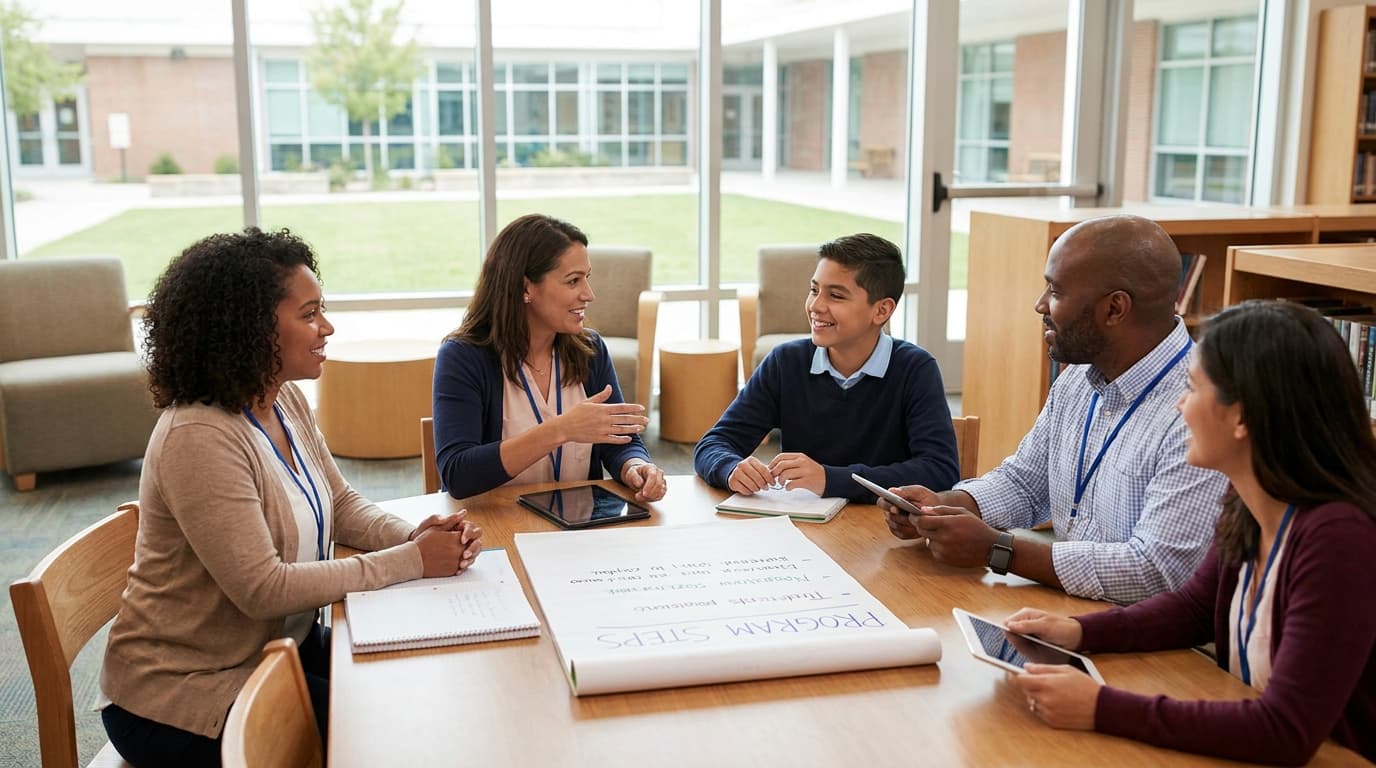
A principal asks a fair question six months after launch. Are we solving conflicts differently, or are we just logging more meetings? If the team cannot answer that clearly, peer mediation starts to look optional the first time staffing shifts, testing season hits, or budgets tighten.

Schools do not keep programs because the idea is good. They keep practices that show a clear effect on student life, staff workload, and school climate.

That is why outcome tracking has to do more than count sessions. A school-wide conflict resolution approach should show whether mediation is resolving disputes, whether students experience the process as fair, whether adults are using the referral pathway correctly, and whether the work is reducing repeat relational conflict over time.

Track a small set of indicators you can sustain

Keep the system lean. If the coordinator needs 20 minutes of data entry after every case, the system will break by October.

Start with a short dashboard that answers practical leadership questions:

  • How many referrals came in
  • How many mediations were completed
  • How many ended with a written or verbal agreement
  • How participants rated fairness, voice, and usefulness
  • How often the same students returned with similar peer conflict
  • What referral patterns show by grade level, location, or source
  • How student mediators are developing in neutrality, listening, and problem-solving

Those measures give a fuller picture than volume alone. A school can complete many mediations and still have weak implementation if agreements do not hold, teachers rarely refer, or student mediators are drifting from the process they were taught.

Benchmarks can help, but they should be used carefully. Schools often see strong agreement and satisfaction when training, supervision, and referral screening are consistent. The more useful question is whether your own numbers improve across semesters and whether they reflect healthier day-to-day conflict handling across classrooms, counseling, and discipline.

Use feedback tools that fit the school day

Short forms get completed. Long forms sit in a stack or disappear into backpacks.

For participants, five questions are usually enough:

  1. Did you have a real chance to speak?
  2. Did the process feel fair?
  3. Do you understand the agreement or next steps?
  4. Does the plan feel realistic at school?
  5. Would you use mediation again for the right kind of conflict?

For student mediators, the reflection should support skill growth, not create paperwork for its own sake. Ask:

  • What helped the session go well?
  • Where did you lose neutrality or momentum?
  • What signs suggested adult follow-up might be needed?
  • What would you do differently next time?

If your team needs a practical model for setting this up, this guide to measuring conflict resolution impact in schools offers a useful school-based framework.

Report impact in terms school leaders can act on

Leadership teams usually want clear answers to three questions. Is the service being used. Is it helping students. Is it worth the time required to run it well.

A one-page semester report is usually enough if it is specific. Include a few trend lines, a brief interpretation, and one anonymized case example that shows what changed because mediation was available. Keep the language operational rather than aspirational.

Report items such as:

  • Referral sources from teachers, counselors, deans, or administrators
  • Completion and agreement rates
  • Student ratings of fairness and usefulness
  • Patterns in repeat peer conflict referrals
  • Common implementation problems, such as scheduling delays or weak agreement quality
  • Specific adjustments needed for training, supervision, or staff communication

This is also the place to show that peer mediation is part of a wider conflict resolution culture, not an isolated elective activity. If classroom referrals become more appropriate, counselors report better handoffs, or administrators see fewer recurring disputes between the same students, that matters. Those are the signs that the school is building a more coherent response to conflict.

Consistency matters more than perfection. Collect the same measures the same way each cycle, review them with the adults who run referrals and follow-up, and use the findings to tighten practice. That is how schools make the case for sustaining peer mediation after the startup energy fades.

Troubleshooting Common Challenges and Ensuring Sustainability

The biggest myth about peer mediation is that once students are trained, the program will run itself. It won't. Schools need ongoing adult structure, especially after the first burst of enthusiasm fades.

When referrals stall

This usually isn't a student problem. It's an adult workflow problem.

When teachers don't refer, do this:

  • Audit the referral process. If it takes too many steps, shorten it.
  • Retrain staff with examples. Many adults need help distinguishing conflict from misconduct.
  • Close the loop. Teachers refer more often when they hear what happened afterward.
  • Reintroduce the program visibly. Staff forget what they don't see in practice.

When confidentiality or quality slips

Student mediators are still students. They need supervision, refreshers, and boundaries.

When confidentiality is breached or agreements are weak, do this:

  • Pause and coach immediately. Don't hope it corrects itself.
  • Use scripted openings again. Strong routines protect quality.
  • Require agreement review by the coordinator for newer mediators.
  • Hold regular debriefs so students can ask questions before habits drift.

A common failure point is assuming the program is mature because it exists. Quality usually drops when schools stop coaching.

When resources are thin

Many schools encounter difficulties at this stage. Under-resourced campuses often lack dedicated staff, private meeting space, and time for supervision. That challenge is real. One example often cited is that El Monte City School District's implementation across 14 schools required a formal five-year partnership with an external organization, highlighting the scale of support schools may need, as described in this discussion of peer mediation implementation barriers.

That doesn't mean smaller schools should give up. It means they should scale wisely:

  • Start with a narrow referral category
  • Train a smaller mediator cohort well
  • Use one coordinator and one regular meeting time
  • Build routines before expanding
  • Use digital supports carefully to reduce scheduling pressure

Peer mediation becomes sustainable when it is ordinary. Staff know what to refer. Students know what mediation is for. Mediators receive coaching. Leaders review outcomes. The school treats conflict resolution as part of education, not as an add-on whenever time allows.


If your school wants a structured way to support conflict resolution alongside in-person practice, WeUnite offers an AI-guided mediation platform that can complement peer mediation, counseling, and restorative systems with guided reflection, empathy-building prompts, and resolution planning in a privacy-respecting format.

📺 Watch & Learn

Video: Peer Mediation in Schools: A Practical Implementation Guide

Deepen your understanding with this curated video on the topic.

▶ Watch on YouTube

More From the Blog

10 Top Workplace Communication Tools for 2026
🏢 Enterprise

10 Top Workplace Communication Tools for 2026

Discover top workplace communication tools for chat, video, async, and conflict resolution. A complete 2026 guide with pros, cons, and pricing.

May 9, 2026 · 18 min read

What Is Empathetic Communication: Your 2026 Guide
🏢 Enterprise

What Is Empathetic Communication: Your 2026 Guide

Discover what is empathetic communication. Our 2026 guide covers core skills, examples, benefits, & exercises to master understanding & move past conflict.

May 8, 2026 · 21 min read

Disclaimer

WeUnite is not a licensed counseling or therapy service, and the people behind it are not counselors, therapists, or mental health professionals. The content on this website and blog reflects the personal views, lived experiences, and common-sense perspectives of our contributors — everyday people who believe conflict can be resolved with empathy, not escalation. Nothing here should be taken as a substitute for professional mental health, legal, or crisis intervention services. If you or someone you know is in immediate danger or distress, please contact a licensed professional or emergency services.

A note on AI-generated content: Artificial intelligence is used to help draft, develop, and refine articles on this website and blog. While AI assists in the content creation process, each article is shaped by the views, values, and editorial direction of our founders and contributors. We are committed to transparency about this and believe that using AI responsibly — in service of authentic human connection — is consistent with everything WeUnite stands for.